When Netflix will soon dump all of Star Trek, and traditional networks are broadcasting less genre television than ever, where do audiences go to get their fix?
Looking back, the last century feels like the moment genre television quietly defined its contract with the audience. Most of those early experiments arrived in short waves, and like the tides, they came and went. Some returned decades later on specialty stations or streaming platforms. And these days, nearly everything is being tucked into quieter shores. Every so often, the tropes that once defined a series are reskinned for a new generation, which is simply how television writing evolves.
From that first wave, some re-dos leaned into long-form storytelling, while others stayed loyal to the standalone format.
The 70s offered a handful of tests, including Shazam! (1974–1976), Wonder Woman (1975–1979), and The Incredible Hulk (1977–1982). The latter proved that if you give audiences a hero they can empathize with, they will follow even an unresolved quest, like Bruce Banner’s search for a cure. Sadly, many genre series never reached a true conclusion. The Time Tunnel (1966–1967) is only one of several 60s science-fiction shows left without closure.
The love I have for Bubblegum Crisis is rather obvious, and as for why upgrade, it’s worth it for Holiday in Bali, the live-action travel journal featuring the voice actresses.
Many older fans will still rave over Bubblegum Crisis, and have no problem buying a re-release as video technology improves. When the audio fidelity is amped up too, maybe one day a simulated concert experience is possible! Also, the 90s was an anime Renaissance which helped show to western audiences that this genre is unique. With the release of Bubblegum Crisis: The Complete Collection, I can say I got everything from my VHS and laser disc days gathered onto two compact discs. And there’s a 50-page booklet containing interviews and staff memories too! Although this is mostly text, I’m fine with that because I own the art books.
I started wanting the latter because of AnimEigo’s covers. They are a testament to how diverse my collection is and I got the latter album cover signed by Kenichi Sonada when he attended Emerald City Comic Con close to a decade ago! Although I missed getting the crowdfunded version of this latest release which had a special art book, I’m sure I could track down the Japanese version. But after meeting Sonada-san and asking for something complete different from others (to have him draw me anime style), it’s tough to top that!
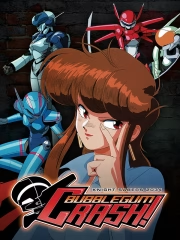
Fans hoping to collect everything Bubblegum Crisis related don’t need to Bubblegum Crash with this update on upcoming releases this year and next.
One great thing that’s been consistent ever since MediaOCD brought AnimEigo into its fold is that fans who missed crowdfunding fond this smaller company’s anime classics is that they’re bringing them back for the masses! This time, Bubblegum Crash is getting a revamped and remastered upgrade that’s sure to say that interest in this series is not being forgotten. This release is set for January 21, 2025.
The timing is terrific because in Oct will be Bubblegum Crisis: Complete Archive Art Book (Amazon link). This collection compiled by Jason Hofius features concept art, model sheets, key visuals, poster art, special magazine artwork and a lot more!
There’s lots to love about this series created by Toshimichi Suzuki, and while news of whether there will ever be a live-action version, that will still take time to gestate. The cinematic movie magic technology is here to make it good, but ultimately it’s up to the creators and Artmic to say yes to moving forward. I suspect the reason everything has stalled is due to not finding a major studio to help produce.
Barack Obama once said, “Let me tell your something. I’m from Chicago. I don’t break.” But we’re betting he never saw the anime, Riding Bean. We also offer the latest news concerning the Japanese release, Bean Bandit.
Release Date: Sept 10, 2024 Available to Purchase on Amazon USA or direct through MediaOCD
Technically, the only thing new in the re-release of Riding Bean is the interview with creator Kenichi Sonada. What he offers are some anecdotes regarding what inspired him to make the anime, and subsequent manga sequel, and he also shares what he loved back then, which he brought over to this series. For example, he talked about I Dream of Jeanie and also Terminator. I won’t give away the deets, but upon checking out this bonus video first, and this short film again, I agree about the latter’s influence. As for the former, that was a “Really?” moment.
Although Sonada-san didn’t say much regarding who he was drawing from for Percy, the police commissioner who is after Bean, I’m guessing he takes after Edward Rooney (Ferris Bueller’s Day Off) along with Walter Peck (Ghostbusters). They share similiar manic characteristics! He’s why I love this short film so much.
Everything you want to know but were afraid to ask about what went on behind the scenes and in the evolution of heavy metal is well accounted for in Sean Kelly’s Don’t Call It Hair Metal. This deft exploration of the 80s music scene in 320 page book published by ECW Press is great at delving into the origin of many famous bands from the 70s onwards. From Slade to KISS to Ozzy Osbourne’s solo career after Black Sabbath, the examination even dives deep to reveal something new about each act that I’m a fan of.
This book isn’t about random bits of trivia. It’s an excellent scholarly study on why a lot of bands are still performing. What they produce is for the love of the sound, not the look, or even the glam that shook up the stage to draw in crowds. Alice Cooper is the godfather of the scene for a reason, and we get some great stories from various talents remembering those times.
Instead of exploring the decade as a whole, each chapter deals with a few years at a time. We get even more studies about how talents like Randy Roads developed their signature sound, and the interviews from industry observers and other fellow guitarists only add to the picture. Whether that’s about their heydays or something anecdotal, I’m certainly enjoying this read. It’s best not to power through this book, either, as there’s a lot of terrific quotes from the talents Kelly interviewed.
This author’s journey to the heart of rock and roll is the same as mine when when I discovered heavy metal at an early age. And to hear the stories about how some bands persevered is sweet. Also, to read about what this author believes are the best platinum hits only affirms why I loved one album over another. For me, Def Leppard‘s Pyromania will always be my number one album to put on the turntable. Twisted Sister never came into my radar until “We’re not Gonna Take It,” and watching them transform into a glam act; but after a while, they took the makeup off and went back to the sound that is their roots.
As this book insinuates, it’s not about the hair, but the intention of why each group wanted to make a dent in the industry. Poison and Ratt were huge during this time, and it’s not because of the acts put on stage, their life behind the scenes or something else. Regarding the former, Brett Michaels’ journey is a book in itself, and it’s been looked upon in those documentaries made by VH1.
Even MTV’s influence is recounted here, and without them and the music videos which showed these bands at their craziest (or best), I doubt this era would be remembered fondly. Kelly’s love for the genre and his personal journey makes for the perfect narrative device to move readers year to year, and I suspect writing Don’t Call It Hair Metal took more than a a year to craft. Although the preview edition doesn’t contain any snapshots, that may change when the hard copy finally comes out.
Release Date: August 2, 2022 GKIDS & Shout! Factory
A sci-fi adventure on the high seas, Nadia: The Secret of Blue Water is the acclaimed television series from visionary director Hideaki Anno (Neon Genesis Evangelion). This award-winning show is loosely based on the works of Jules Verne, and its popularity later inspired a film, manga, and video games.
This release boasts an all-new 4K restoration, and includes all 39 episodes of the series in both the original Japanese and an English dub, as well as a number of bonus features including a new booklet featuring character and mechanical designs from the series, a sneak-preview featurette, a TV spot, and more! Fans can preorder their copies now by visiting ShoutFactory.com or GKIDS.com


 Looking back, the last century feels like the moment genre television quietly defined its contract with the audience. Most of those early experiments arrived in short waves, and like the tides, they came and went. Some returned decades later on specialty stations or streaming platforms. And these days, nearly everything is being tucked into quieter shores. Every so often, the tropes that once defined a series are reskinned for a new generation, which is simply how television writing evolves.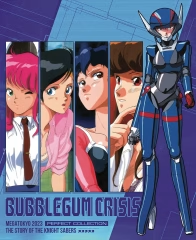
 One great thing that’s been consistent ever since
  Release Date: Sept 10, 2024
