

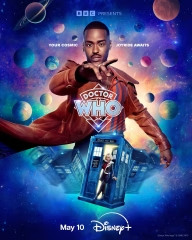
 A lot has changed with The Doctor over the years. And to say which Doctor Who incarnation is better depends on whom you ask, which generation they’re from and if the show can survive the test of time. As for why The Beatles was chosen over the The Who to market the new era under Disney’s distribution network, that’s because the British Invasion with the former really changed the landscape of the music industry. Both gained recognition around the same time (1964).
With today’s woke culture inspiring Russell T. Davies to further change all that was classic with the series, I’m not as keen to call myself a fan of everything new. The Doctor’s reward of getting a new set of regenerations (“Time fo the Doctor”) is because he saved his homeworld from complete destruction. Unlike The Master, when he transferred his essence to other bodies to extend his own cycle (this character was originally male), the Doctor was keen to expire and let someone else save the universe. But the BBC said we can’t put an end to their best known media empire.
To explain how regenerations work, it’s all because of the power a black hole contains. If one can harness the energy from the singularity, it can supercharge the cells of a Gallifreyan body. The Eye of Harmony was made to contain all this power, and as for why this is important, perhaps Ruby (Millie Gibson) has some ability to tap into that or be a storehouse of energy too. Continue reading “Talking About A New Generation with Doctor Who’s 14th Season (or is that one?)”
 Spoiler Alert