

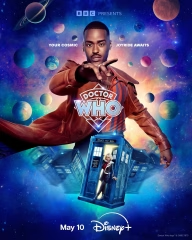
 A lot has changed with The Doctor over the years. And to say which Doctor Who incarnation is better depends on whom you ask, which generation they’re from and if the show can survive the test of time. As for why The Beatles was chosen over the The Who to market the new era under Disney’s distribution network, that’s because the British Invasion with the former really changed the landscape of the music industry. Both gained recognition around the same time (1964).
With today’s woke culture inspiring Russell T. Davies to further change all that was classic with the series, I’m not as keen to call myself a fan of everything new. The Doctor’s reward of getting a new set of regenerations (“Time fo the Doctor”) is because he saved his homeworld from complete destruction. Unlike The Master, when he transferred his essence to other bodies to extend his own cycle (this character was originally male), the Doctor was keen to expire and let someone else save the universe. But the BBC said we can’t put an end to their best known media empire.
To explain how regenerations work, it’s all because of the power a black hole contains. If one can harness the energy from the singularity, it can supercharge the cells of a Gallifreyan body. The Eye of Harmony was made to contain all this power, and as for why this is important, perhaps Ruby (Millie Gibson) has some ability to tap into that or be a storehouse of energy too.
The attraction between her and number 14 (Ncuti Gatwa) is electric, and although she doesn’t know it, he’s curious about her. It’s referenced in “Space Babies” and as for why Maestro (Jinkx Monsoon, who gave the performance of a lifetime), a not so typical villain, consumes souls in “The Devil’s Chord” boils down to two things:

There’s theoretical physics and demonology. Everything that exists in the cosmos has a vibration, and Pythagoras’ music of the spheres is scientific fact. I surmise it binds the universe together and the implication is there are forces seeking to cut that is chilling. As for the latter, most stories love showing demons feeding on the energy of mortals. That’s because the soul has electrons. When agitated a certain way, it is like wine or battery acid to those who need it.
Ultimately, it’s become what physicists are still trying to figure out today–string theory. All these little scientifically possible details made parts of “Devil’s Chord” a worthwhile watch. Although it doesn’t delve into saying this demon is an antithesis of Calliope, the naming conventions hint she’s as old as the Greco-Roman gods. This character uses the pronoun of they; if that’s not an attempt to match today’s’ gender politics then I don’t know what will.
Ultimately, the ideas presented are what makes this episode a better introduction than the previous one. I couldn’t get through it at all and jumped to view episode two. A big question I have concerns past times when the same set of notes were played. Why didn’t Maestro didn’t appear back then? Was it because Tim was special, and they have been waiting? It’s hypocritical to say it was never played before and just why they didn’t emerge before is a huge plot hole. The only other possibility is that the complete score had to be played to invoke magic similar to Nelvana’s Rock and Rule (Amazon link).
As for their relationship with The Toymaker (the two wear similar lavish costumes), and their purpose in this cosmos it makes me think there are forces that created the Big Bang, and they’re watching everything transpiring like a TV program–perhaps the only way to explain the fourth wall breaking moments.

This concept also got me to think this episode has some connection to the Sandman universe. In addition to the Endless, The Old Ones are entities older than time and space. Also, I was reminded of the Books of Magic when considering who Timothy Drake (instead of Hunter) is, and the actor chosen has a remarkable resemblance. Technically, Davies is most likely referring to the artist who released “Symphonies Of The Planets,” but I sensed more.
Unfortunately, I cared less for the very Disney inspired approach Monsoon took in playing Maestro. She made me think that Ursula from The Little Mermaid was her role model. As for turning music into visible objects like a cartoon effect, I was reminded of The Peanuts where Woodstock would sometimes interact with the notes flying around. And I’m sure the Easter eggs don’t end there.
And as for that showdown between The Doctor and Maestro, honestly, I’d rather watch Ralph Macchio’s epic guitar battle with Steve Vai in Crossroads instead. That movie’s climax was intense and this episode’s attempt barely matched that. As for the large song and dance number at the end, it hardly made sense. While some eagled eyed Whovians say it foreshadows the return of Susan Twist, I don’t feel invested in the new Who lore to care.
I firmly believe that BBC/Disney’s Doctor Who jumped the shark. While Ncuti Gatwa is great for a modern audience and is sexy to boot (he has the buns of steel to prove it), he’s not the quirky Time Lord I love. I suspect this studio’s main goal is to save this ailing BBC series for all the wrong reasons. It’s still on life support, and it should’ve been left to become part of pop culture history instead of getting reinvented.
Doctor Who Season 14 Promotional Trailer
https://www.youtube.com/watch?v=xhL5ihOUUcs
