

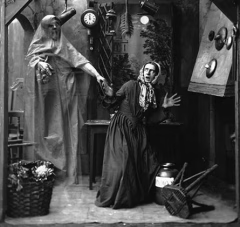
 From the early days when individuals wanted to make contact with the other side to present day, the choices in what to use as paranormal tech is few. They ranged from candles and balls of string to devices that became precursors to what’s used today. Back then, the people didn’t use stuffed dolls programmed to respond to strange activity. And REM pods is still considered a novelty. Some of these toys were created, rooted in belief at the time, and others are just plain weird.
This guide explores some of the most imaginative, audacious, and occasionally fraudulent contraptions created by folks with nothing better to do. Not all of them are truly useful, and if there’s ever a museum to showcase these curiosities, maybe they might rattle out a result to make the observer go hmm. What’s being sought out here is the reason why these creators made these devices. Some of them are precursors to what’s used now, improved by modern engineering; others are best left to rest as oddities in a trade that’s never going to be truly mainstream. Included are the inventors of their respective “toy,” when images of the product are lacking, or so varied, where no one version can say it all.
The Inventors and Their Experiments
Every age breeds its own scientific dreamers, those who believed the afterlife could be coaxed into cooperation with pulleys, light, or electrical current. Whether they sought truth or spectacle, each brought the language of their era’s science to the séance table. Since they did not invent a single item, what they pioneered is still in use today, in one form or another.
William H. Mumler (1860s)
The Spirit Photographer
 Who: William H. Mumler (1832–1884), Boston engraver turned photographer.
What: Pioneered “spirit photography” by double-exposing glass plates to create ghostly figures beside living subjects. His images — most famously of Mary Todd Lincoln with Abraham Lincoln’s “spirit” — captivated the grieving post–Civil War public.
Motivation / quote:
“The form of a young girl appeared beside me upon the plate, though no one was present. I knew not what to think — it was as if the veil had parted.”
Notes on credibility: Exposed in 1869 by showman P.T. Barnum during a fraud trial, but Mumler’s work established photography as a supposed tool of spirit revelation.
Sir William Crookes (1870s)
Instrumental Research into Mediumship
 Who: Sir William Crookes (1832–1919), British chemist and physicist, discoverer of thallium.
What: Developed a variety of experimental instruments — galvanometers, pressure gauges, and “radiant matter” tubes — to test spiritualist phenomena, particularly the materializations produced by medium Florence Cook under the guise of “Katie King.”
Motivation / quote:
“I have tested her by every experiment that my knowledge could suggest, yet I cannot account for the results by any known physical law.” — Researches in the Phenomena of Spiritualism (1874)
Notes on credibility: Crookes was criticized for lacking scientific control, but his instrumentation pioneered attempts to quantify séance phenomena.
Thomas Alva Edison (1920)
Proposed “Spirit Communication Machine”
 Who: Thomas Alva Edison (1847–1931), American inventor.
What: Publicly mused about constructing a device capable of detecting or amplifying traces of consciousness post-mortem. Although no working model was produced, his statements in Scientific American and later interviews fuelled decades of myth about a “spirit phone.” His rival, Nikola Tesla, was rumoured to have built a similar device; however, his experiments were aimed at astronomical phenomena rather than the spiritual. The notion that he dabbled in the paranormal is pure speculation.
Motivation / quote:
“If our personality survives, then it is strictly logical or scientific to assume that it retains memory, intellect, and other faculties… If we can evolve an instrument so delicate as to register psychic forces, we shall have established that survival.”
Notes on credibility: No prototype confirmed. Edison’s public remarks were speculative but reveal early 20th-century fascination with combining electrical science and spiritualism.
Friedrich Jürgenson (1959)
First Electronic Voice Phenomena (EVP) recordings
 Who: Friedrich Jürgenson (1903–1987), Swedish artist, filmmaker, and archaeologist.
What: Accidentally recorded what he believed were voices of the deceased while taping birdsong, then spent the next decade refining radio-microphone setups to reproduce “trans-dimensional” voices. The question of what it’s recorded has some people debating sources. In terms of debunking, maybe there is someone in the woods camping.
Motivation / quote:
“I heard my mother’s voice calling my name. It was clear, tender, and human — beyond all doubt.”
Notes on credibility: Inspired generations of EVP researchers, leading directly to Konstantīns Raudive’s later systematization.
Konstantīns Raudive (1960s–1970s)
Electronic Voice Phenomena systematization
 Who: Dr. Konstantīns Raudive (1909–1974), Latvian psychologist and philosopher.
What: Building on Jürgenson’s findings, Raudive devoted over a decade to refining EVP methods, employing radio–microphone loops and custom filters to detect and classify spirit voices. His 1971 book Breakthrough catalogued thousands of recordings and inspired subsequent generations of researchers and hobbyists.
Motivation / quote:
“The voices are there, the evidence is clear. It is for the world to decide what they mean.” — Breakthrough
Notes on credibility: Many voices can be attributed to interference or pareidolia, but Raudive’s disciplined cataloguing transformed EVP from fringe curiosity to formalized pseudoscientific practice.
Frank Sumption (2002 onward)
The Ghost Box
 Who: Frank Sumption, American inventor.
What: The “Frank’s Box” or “Ghost Box” is an open-loop radio receiver scanning AM/FM bands to produce real-time audio snippets believed to facilitate two-way communication with spirits. The question of whether this piece of paranormal tech works or not is subject to debate, but as numerous devices have “improved” upon the technology, the question still remains, whose voice is it anyways?
Motivation / quote:
“Electronics are merely the medium. The voices exist in the energy field around us.”
Notes on credibility: Audio pareidolia remains the primary explanation, but the design continues to influence hobbyist and media portrayals of ghost detection tech.
Together, they form a continuum of curiosity — from levers and pulleys to oscillators and radio static — each convinced that a whisper in the dark could be measured, translated, and understood.
The Devices and Contraptions
Once the minds were in place, the machines followed. Every contraption here is a kind of prayer rendered in metal or wood, hoping to make the invisible visible.
The Planchette & Talking Board (1850s–1890s)
 Who: Planchette introduced by French spiritualists (with earlier ideomotor studies by Chevreul informing the idea); American Ouija Board later patented (1891) by Elijah Bond and marketed by William Fuld.
What: Writing and talking boards automated spirit communication by translating minute unconscious muscle movements into written or spelled messages.
Motivation / quote: Early advertising positioned the board as both parlour entertainment and genuine divinatory instrument:
“Never-failing amusement and mysterious results!”
Notes on credibility: Despite obvious ideomotor origins, planchettes remain culturally persistent, bridging technology, superstition, and social play.
The Ectoplasm Cabinet (1880s–1910s)
 Who: Popularized by spiritualist mediums such as Florence Cook, Eusapia Palladino, and Eva C. (Marthe Béraud).
What: A curtained enclosure designed to “concentrate psychic energy” during séances. Inside, mediums produced luminous cloth-like ectoplasm, faces, and hands said to be spirit manifestations.
Motivation / quote:
Medium Eva C. described her work as “the effort of the invisible to assume a form the living can behold.”
Notes on credibility: Subsequent investigations found fraud (cheesecloth, muslin, and luminous paint), but the cabinet remains an icon of early psychical theatre than a true piece of paranormal tech to prove life after death.
The Spiritoscope (1890s optical variant)
 Who: Attributed in periodicals to an anonymous British inventor (c. 1891) because varients existed. Later on, the build that’s best recognized is credited to to Robert Hare (1781–1858), American chemist and professor at the University of Pennsylvania. He made a gersion which is a mechanical lever-and-dial device meant to record spirit messages without direct human interference.
What: A device combining prisms, lenses, and phosphorescent plates intended to detect “luminous etheric forms.” Essentially a pseudo-scientific periscope for viewing spirits; it epitomized late-Victorian gadgetry.
Motivation / quote:
Described by its maker as “an instrument to reveal that which lies between the vibrations of light and thought.”
The Psychograph (1930s)
 Who: Henry C. Lavery; marketed by The Psychograph Company.
What: Mechanical device resembling a typewriter helmet; claimed to assess personality traits via head measurements and pressure sensors, aligning with both phrenology and “psychic analysis.”
Motivation / quote: Promotional slogan:
“See your soul’s blueprint — instantly!”
Notes on credibility: Now recognized as pseudoscience; a transitional curiosity linking Victorian phrenology to early 20th-century psychological instrumentation.
The Kirlian Camera (1939 and later)
 Who: Semyon and Valentina Kirlian, Soviet electricians.
What: High-voltage corona discharge photography that captures glowing “auras” around living and inanimate objects.
Motivation / quote:
“The energy of life is visible to those who know how to look.”
Notes on credibility: The glow results from moisture and ionization; nonetheless, Kirlian imagery reinvigorated belief in bio-energy fields and psychic photography.
The Ghost Meter & K2 (1990s–2000s)
Who: Various electronics hobbyists repurposing EMF meters.
What: Handheld detectors measuring electromagnetic fluctuations, interpreted by some investigators as signs of spiritual presence.
Motivation / quote: Field manuals often claim:
“Spirits disturb the EM spectrum as they manifest.”
Notes on credibility: Derived from electrician’s safety gear; an example of the modern consumerization of ghost-hunting tech.
These devices trace the same longing through changing technologies: the urge to trap a phantom in a lens, a spark, a signal. Their inventors believed that with the right calibration, the afterlife would stop being metaphor and start being measurable.
Sidebar – Lost and Forgotten Oddities
- The Galvanic Séance Table (1850s): wired magnets made furniture move with uncanny precision.
- The Psychomanteum (1980s): a mirror-lit booth for summoning visions through reflection.
- Theremin’s Aetherphone (1920s): not built for ghosts, yet forever the soundtrack of them.
What Will the Next Big Thing Be in Paranormal Tech? Closing Thoughts
From candlelight to cathode rays, humans have kept building machines for mysteries. Each device — however naïve, however fraudulent — tells the same story: the need to measure wonder. Whether a Spiritoscope’s dial, a phonograph cylinder, or a radio’s hiss, all share a common heartbeat: our refusal to accept silence from the other side. With laser grids and trigger devices now the norm, and environmental sensors sometimes used and sometimes not, perhaps the future lies in creating a device that unites them all — a single, contained unit that spares investigators from hauling several suitcases of gear into the dark.
There will never be a device that credibly declares, “A ghost is here.” All anyone can truly do is quantify and record. Yet to satisfy the skeptics, perhaps a closed experimental chamber makes sense — one that eliminates external variables and measures what might move of its own accord. Outfitted with embedded sensors, such an environment could record what’s invisibly present rather than merely suspected. It’s a logical step when you consider the history of innovation used to court evidence of the other side.
It’s less about trapping an entity, as Egon Spengler once dreamed, and more about determining whether a soul can manifest after losing its physical body.
Everything used in investigations so far demonstrates one thing nearly everyone is searching for: that elusive trace that persists after death. Until we design a device capable of proving that an ounce of energy possesses sentience, we can only listen for echoes — or decide that what we’re hearing is the universe repeating itself after a life is gone.
