

 Although Josh Gates told the story better on Tales from the Explorers Club, the sheer melodrama and hell the crew of the Endurance faced while attempting the first land crossing of Antarctica are something to behold when retold on stage. Melissa Taylor’s adaptation, The Ice Keeps, offers a different take that generally works.
What’s presented during the Victoria Fringe Festival is clearly more of a work in progress than a finished show. Another producer and more funding could elevate the visual elements and make this interim version feel fuller. Taylor mentioned future plans, so her take may yet be explored further. I’ll gladly return to see the updated version, should it set sail, because I want to experience a full-on recreation of the environment rather than the drama alone.
That need for more money also echoes an idea within the play. Shackleton considers how lectures, exclusive interviews and Hurley’s moving pictures can sell the expedition before anyone knows whether his crew will return. Exploration becomes both an act of survival and a story that must be marketed.
At its heart, the performances are strong. Four actresses pull triple duty, playing a range of characters that includes Sir Ernest Shackleton (captain), Frank Wild (second-in-command), Lionel Greenstreet (first officer), Alfred Cheetham (third officer), Hubert Hudson (navigator) and Harry “Chippy” McNish (ship’s carpenter). There are more characters, but without a proper playbill matching each role to the performer, I won’t try to sort that out. These figures anchor a classic tale of man against nature. Instead of giving everyone equal time, the story focuses on those in command.

Mrs. Chippy provides more than comic relief. The cat’s illness and burial mark the shift from high-spirited adventure to survival, giving the crew’s compassion a concrete emotional focus.
I’m sure the production takes a few liberties to give the adventure some lighter moments. Trimming about 10 minutes might help, since a few sections drag, especially when the fragmented storytelling tries to establish who struggled to stay sane and when. I also wanted more visual detail rather than having to rely so heavily on theatre of the mind.
One line warns, “Ernest, you won’t make it,” which made me do a double take. In context, it’s a prediction about his dangerous voyage to South Georgia, not a claim that he died. The delivery still had me second guessing what I heard.
And for those who don’t know the story of this expedition, the crossing itself never happened, nor did the crew face the zombie penguins from At the Mountains of Madness. Yes, they came close, and that’s when I paid the most attention. And no shoggoths were harmed in the writing of this review.
What surprised me upon closer examination is how firmly the horror is already embedded in the text. The River Styx is directly invoked, Orpheus enters the imagery and an unexplained presence appears to walk beside Shackleton’s party. The cursed Belgica, haunted planks, unnervingly silent penguins and abyss-like ocean all make the underlying horror clear: the crew has to survive.
Even the title lands like a warning. Shackleton begins the thought, “What the ice gets…” and the ensemble completes it: the ice keeps. That refers to more than the lost ship. The ice threatens to retain the crew, their sanity and Shackleton’s obsession.
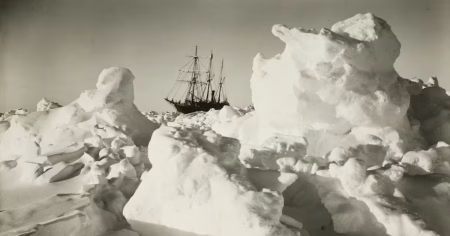
Since the backdrop and visual aids can only do so much, stronger scenic design might hammer home those metaphors. The long monologues intentionally move between interior thought, narration and dialogue. My issue isn’t that real men wouldn’t speak this way. Without stronger visual support, those shifts can blur the timeline and slow the momentum. When the environment matters as much as the performances, the production needs a better balance. That way, what’s presented can feel more personal and analogue.
I can forgive those limits in a proof of concept, especially since the story inverts a few things by having an all-female cast play male roles. The repeated language about the “new man,” the “everyman” and what constitutes “the life of a man” gives that choice greater purpose. The production isn’t merely gender-flipping history. It’s examining masculinity from outside it.
With that in mind, empathy and community become more prominent than any male trying to assert himself. Compassion is demonstrated through action. The crew shares its rationed milk, everyone volunteers for the dangerous rescue voyage and injured men physically support one another. The final roll call confirms that all 28 survived, making their collective endurance more important than one man’s heroic reputation.
That’s where the play’s strongest dramatic arc emerges. Shackleton begins by asking when the everyman will have his day and wants to prove his worth through glory. Emily’s recurring question, “What glory have you brought home, Ernest?” follows him throughout the expedition. By the end, saving his crew has transformed his answer. He hasn’t brought home glory. He’s done something good.
Part of me still wanted the production to lean further into the secrets held at bay, à la Casey Walker’s Ithaqua. With that work still fresh in my mind because it successfully made the environment come alive, I carried some unintended expectations into this performance. Had the staging leaned harder into survival horror, I’d probably have enjoyed the show more. As it stands, the script contains a tale steeped in fear and dread, but the production walks a fine line between a gender-flipped retelling of history and a frozen nightmare without fully making the latter visible.
Final Show of The Ice Keeps
Sept. 6 at 1:00 p.m. at SKAM Satellite Studio (849 Fort Street)
For the latest updates about this show, please visit hapaxtheatre.com/
