

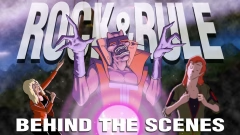
 This year, FAN EXPO Canada is hosting a prime time Saturday reunion panel and special screening of Nelvana’s 1983 animated cult classic, and yes this is Rock And Rule reunion that won’t be visiting other events. It’s a one-off special event that also includes a screening of the classic.
And Verne Andru, credited on the film as Verne Andrusiek, will take the stage alongside director Clive Smith and fellow Nelvana co-founders Michael Hirsh and Patrick Loubert to talk about this unique piece of animated history, and for Hirsh, he will have his new memoir, Animation Nation: How We Built a Cartoon Empire, ready, and Loubert’s appearance is being billed as a rare, historic one. Even Andru’s new book, Rock & Rule Behind The Scenes, is ready to dive into the history of, and serve as an archive for those long-time fans.
By now, those fans have heard about a warehouse storage tragedy that destroyed much of the studio’s physical history, and a lot of what happened on the ground floor of Rock & Rule’s production was thought to be gone for good. Andru was a layout artist hired by Smith, translating storyboards into the camera and architectural blueprints animators actually worked from, the kind of job that keeps a film running but rarely gets remembered once the credits roll. He just happened to hang onto his files.

“In a massive studio system, you do the heavy lifting, hand it in, and you’re moved on,” Andru said in the announcement. “When the storage fire happened, an irreplaceable chunk of that collective legacy vanished. This book isn’t about studio politics, it’s about showing the actual working drawings, technical charts, and production secrets from the drawing boards of the people who built the film frame by frame.”
Fans attending will be able to pick up the book, a screen-accurate replica of the film’s “I Survived Mok Concert” T-shirt, and a limited run of original production drawings Andru pulled off his own 1980s studio desk.
On Why Rock and Rule Reunion Matters
For anyone who hasn’t stumbled onto it yet, Rock & Rule (released internationally as Ring of Power) is one of those films whose story off screen is almost as wild as what’s on screen. It started life in 1978 as a children’s film called Drats!, riding off the success of Nelvana’s TV special The Devil and Daniel Mouse. There was no finished script going into production, and the tone kept shifting as animation was already underway.
One major character had to be redone from scratch after entire sequences were already shot on film. By the time it wrapped, the cute animal fable had turned into a post-apocalyptic rock musical about mutant descendants of cats, dogs, and rats living in the ruins of a world destroyed by nuclear war, with a plot that leaned into sex, drugs, and demon worship along the way.

It went years over schedule and millions over its $8 million budget, and MGM/UA, frustrated with the delays, cut about ten minutes from the American release before giving it almost no marketing or theatrical push. The film made roughly $30,000 back in theatres. That kind of box office would sink most productions for good, and it nearly did sink Nelvana.
What kept this film alive was everything MGM couldn’t cut out. The animation used early computer-assisted imagery and multiplane photographic techniques that were genuinely ahead of their time, giving the film a depth most cel animation from that era couldn’t touch. Then there’s the soundtrack, an oddball lineup of Debbie Harry, Lou Reed, Iggy Pop, Cheap Trick, and Earth, Wind & Fire, all writing original music for the film. The villain, Mok Swagger, was designed as a mashup of rock stars like Mick Jagger, David Bowie, Iggy Pop, and Lou Reed, and it shows.
Rock & Rule also holds a specific place in Canadian animation history as one of the country’s first English-language animated features, a genuine swing for the fences from a studio best known at the time for kids’ programming. It bombed on release and found its real audience later, on home video and television, the way a lot of cult films do. Decades on, critics and animation historians treat it as one of the more fascinating failures in the medium, a film that was too strange and too far ahead of its marketing to survive its own moment.
That’s what makes this Fan Expo reunion worth paying attention to. It’s not just a nostalgia panel, it’s four of the people who lived through that chaos, sitting down together to finally tell the story from the inside.