

 Long before malls blared carols and Santa slid down chimneys, winter belonged to stranger things. From the shadowed Alps to the frozen fjords, there are other entities said to roam the land. Throughout Europe, some were mortal, others were spirits, and maybe one or two were fae. These Winter Solstice Legends existed in legend and folklore as a friend to Saint Nick, or perhaps served as a gentle reminder of Winter’s power, or perhaps why one must be kind to others!
As avatars of them perform in festivals, their true presence manifests in the songs and stories told over the warm fire. Whether in the comfort of a home or in camp, just what’s revealed keeps some thoughts safe. And in what I hope is a comprehensive list, what I offer is what I’ve learned so far about these legends.
The Caganer
(Catalonia, Spain)
 Often hidden in plain sight, the Caganer turns the act of searching into part of the ritual; finding him is said to bring luck, while failing to include him invites misfortune or poor crops. His origins likely trace back to 17th- and 18th-century Catalonia, when peasant realism and earthy humour seeped into religious art as a quiet counterbalance to idealised piety.
By squatting at the margins of the holy scene, he affirms that divinity does not float above daily life but is embedded within it, bodily, messily, and without shame. In this sense, the Caganer functions as a solstice figure in disguise, anchoring cosmic renewal to manure, labour, and the cycles of the land. Modern versions depicting politicians, celebrities, and pop-culture icons extend the joke further, democratising the sacred moment and reminding everyone, saint and sinner alike, that nature makes equals of us all.
Futher Reading: BBC Report: Catalonia’s Beloved Scatological Christmas Custom
The Christkind
(Central Europe)

Though presented as a gentle child, the Christkind carries a quietly radical theological payload. Martin Luther promoted the figure not merely to sideline Saint Nicholas, but to shift attention away from saints entirely and back toward Christ as the spiritual centre of the season, with gifts reframed as acts of grace rather than reward. Over time, this abstract religious symbol softened into something folkloric, often portrayed as an ethereal, feminine angelic presence, blurring gender and age in a way that makes the Christkind feel more like light incarnate than a literal child.
In public appearances, especially at Christmas markets, the Christkind functions as a liminal being, opening festivities much like a ceremonial key-bearer, blessing commerce, community, and cold air alike. One varient is the Czech Ježíšek; just whether they belong to the same pantheon depends. Beneath the tinsel and choirs, the figure preserves a solstice logic: a small, luminous presence holding back the dark, not through authority or judgment, but by simply existing as a promise that light returns.
Further reading: Czech Christmas traditions explained, Radio Praque International.
Ded Moroz
(Russia, Belarus, Ukraine)

At the end of every year, it’s widely believed Grandfather Frost, the regal spirit of winter, travels with his granddaughter Snegurochka, the Snow Maiden, to deliver gifts. He was once a personification of frost’s cruelty, but over time, his role changed. This guardian of endurance and renewal was deliberately reshaped into a secular winter figure, allowing ancient seasonal symbolism to survive beneath modern ideology. His long blue robes and staff preserve the Slavic reverence for the cold.
Further reading: Russiaopedia
Frau Perchta
(Austria, Germany)

A spectral figure who roams the Twelve Nights after the solstice is known to reward those who worked hard throughout the yuear, and for those who did not, will punish! Much like other figures from folklore who search out the lazy, just what these legends represent is reward after the final harvest, for a job well done!
Sometimes beautiful, sometimes monstrous, she represents winter’s balance of justice and consequence. Folklorists trace her to pre-Christian goddesses of fate and domestic order. Alpine Perchtenlauf parades still celebrate her dual nature with masks, bells, and torchlight.
Further reading: Writings of Jacob Grimm; Alpine ethnographic studies.
Grýla and the Yule Lads
(Iceland)
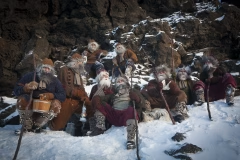
High in the mountains dwells Grýla, an ogress who descends at midwinter is known to capture misbehaving children. Accompanying her are thirteen sons, the Yule Lads. They visit homes on the nights before Christmas. And like their other kin, these helpers leave gifts or cause mischief based on what that family has done.
Althoug there hasn’t been a movie made about the latter, it’s safe to sort of associate them with Joe Dante’s Gremlins. They were once terrifying, but now, they embody Iceland’s playful folklore spirit. Each Lad has a name to represent a particular prank.
Further reading: National Museum of Iceland archives.
Jólakötturinn (The Yule Cat)
(Iceland)
 This gigantic black cat is believed to prowl around during the holidays, looking for those who do not get clothes for Christmas. For anyone who did not receive any, they quickly get devoured! Fortunately, socks and thermal underwear count. But for those without anything to keep them warm, well, perhaps that’s where this legend sprung form.
Rooted in old farm traditions, the tale encouraged diligence during the wool harvest. In modern Reykjavik, the Yule Cat looms as sculpture and song, a monument to hard work rewarded. And for those who don’t earn their keep, it’s said they will terrorize.
Further reading: Árni Magnússon Institute for Icelandic Studies.
Joulupukki
(Finland)

Before he was softened into a version of merry old Saint Nick, this “Yule Goat” was a horned figure demanding offerings rather than gifts. But that history is far from the truth. He’s one of the most pagan of these winter solstice legends.
In Finnish folklore, this ol’ goat represented more. He was there to judge, to test hospitality, and sometimes to frighten children into obedience. In some regions, he carried a whip. In others, he asked directly whether children had behaved, and it’s best to be honest. This figure changed when Christian Missionaries swept through the region. He’s no longer the dreaded entity but rather a transformed figure. For better or worse, just who is become is basically a localized version of Santa Claus.
Further reading: Scandinavian Mythology: An Introduction by John Lindow
Kallikantzaroi
(Greece, Cyprus, Balkans)

Goblins of the underworld who emerge during the Twelve Days of Christmas to sow chaos, spoiling food, tangling hair, and frightening livestock. For most of the year, they saw at the World Tree that holds up the earth, only to find their work undone when they return. Their cycle mirrors the winter solstice itself: darkness surges, then retreats.
Further reading: TheGreekVibe.com along with studies in Greek and Balkan mythological studies.
In Part Two of Winter Solstice Legends:
We will look at the one of the most iconic representatives of the season. It’s safe to say Krampus is well represented in Western pop culture media, and those takes stay loyal to the lore, but what else do we know about him?
Discover more from Otaku no Culture
Subscribe to get the latest posts sent to your email.
