

 Coming to Amazon Prime Nov 20th
There’s a big question that hasn’t been answered yet: who can be hailed as the next Walt Disney? Naming a successor is tough. Whether that person would even accept the title depends on what they enjoy most about working in animation and entertainment. Then there’s the question of how they’d move the medium forward. After watching Don Bluth: Somewhere Out There, I’d rank Bluth as a proper visionary. He learned while working at the House of Mouse, received advice from Walt himself, and carried forward what made the studio’s golden age special.
Other figures deserve recognition too. To name a few, Chuck Jones, Tex Avery and Max Fleischer each contributed something unique. While they aren’t the focus here, I’d also love to know what motivated them before they made their names. What a documentary explores depends on what its filmmakers want to tell. Here, Dave LaMattina and Chad N. Walker blend critique, biography and retrospective into a celebration of Bluth’s career and his studio’s milestones.
The man himself has little appetite for corporate agendas, business dealings or arguments over money. He knows the bills have to be paid and his staff need their wages. At heart, though, he wants to recapture what made those early Disney films special. And when he left this studio, a fair number of animators joined him. In addition to nine unnamed individuals, there were also co-founders Gary Goldman and John Pomeroy, who decided that they could form their own studio. The goal was to bring back that golden age and not necessarily fight their former bosses.
Of course, I couldn’t help noticing a few blatant jabs indicating what Walt Disney Studios has become. It’s more about the suits than the creatives. If I had to add to that commentary, the executives’ concern with quantity over quality says it all. And I want more TRON!

Later in this work, there’s a fascinating segment about Roy Disney offering a nice payout just to bring Bluth back to the company. As Bluth recalls it, his refusal earns the response, “We will crush you.” Boo. Had that conversation gone differently, his independent career might have taken another path. Instead, the exchange reveals how quickly a former colleague can become a rival.
We also get to see the production process before computers and hear how technology helped keep the studio afloat. Dragon’s Lair changed everything! Still, success in the arcade wasn’t enough to secure the company’s future. Its work with Steven Spielberg became the next focus as the studio struggled to stay in business. Between archival footage and new interviews, I feel I’m getting to know the man even more.
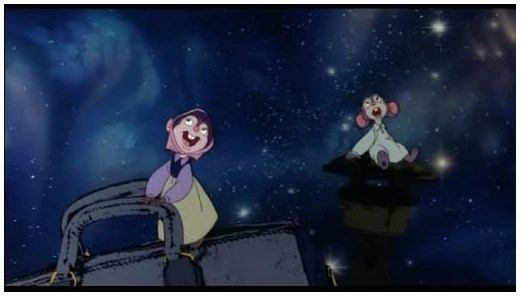
 What’s also cool is seeing production artwork for concepts that never materialized, including Little Blue Whale and Jawbreaker. These glimpses give us a sense of the ideas brewing beyond the films that reached the screen. A montage of media responses to An American Tail credits the studio with rekindling our love for the cartoon medium. That’s quite a legacy, but acclaim doesn’t make the business side any easier.
Back then, Bluth knew his company was living on borrowed time. The pressure went beyond its two bankruptcies. When Spielberg asked whether a sequel to Fievel’s tale could be made for less money, Kathleen Kennedy’s question, “Are you sure you want to say that to Steven?” revealed plenty about the business side. Of course, this filmmaker formed Amblimation, which made a continuation, and fans can argue over that IP’s longevity.
These details make the documentary a fascinating look at the industry from last century. Staying competitive involves more than keeping up with technology. Even so, after seeing what CGI can do in Toy Story, Bluth recognises rough waters lie ahead.
To see the studio struggle during the 90s was especially hard to watch. The conflict between executive demands and artistic vision, which Bluth and company left Disney to escape, crept into their own operation. Although there were not many alternate studios back then to deliver films (as Nelvana was Canadian and a world away), I’d love to see how other studios got their chance on the big screen. Not everything has to be Disney, and I feel that’s part of what LaMattina and Walker manage to say by the end.
 Even this studio’s co-founders understood how difficult this road could be. Those who follow the trio accept that they may have to walk 5,000 miles to find success, if not 5,000 more. Yes, the Proclaimers song comes to mind as I follow this filmmaker’s journey as an artist, storyteller and much more. He accepts that path, and that’s what makes his story special.
For viewers who want to know more, Bluth’s autobiography, Somewhere Out There: My Animated Life (2022; Amazon link), offers another way into his story. I’m curious how much of the roughly two decades this documentary leaves unexplored it covers. The ending is a little sad, and even though this storyteller/animator says he has no regrets, I sense there’s that little mini-me asking, “What if?” What begins as a biography becomes a broader look at an industry where artistic ambition and business demands don’t always agree. Through it all, Bluth’s love for animation comes through.
4 Stars out of 5
Don Bluth: Somewhere Out There Trailer
