

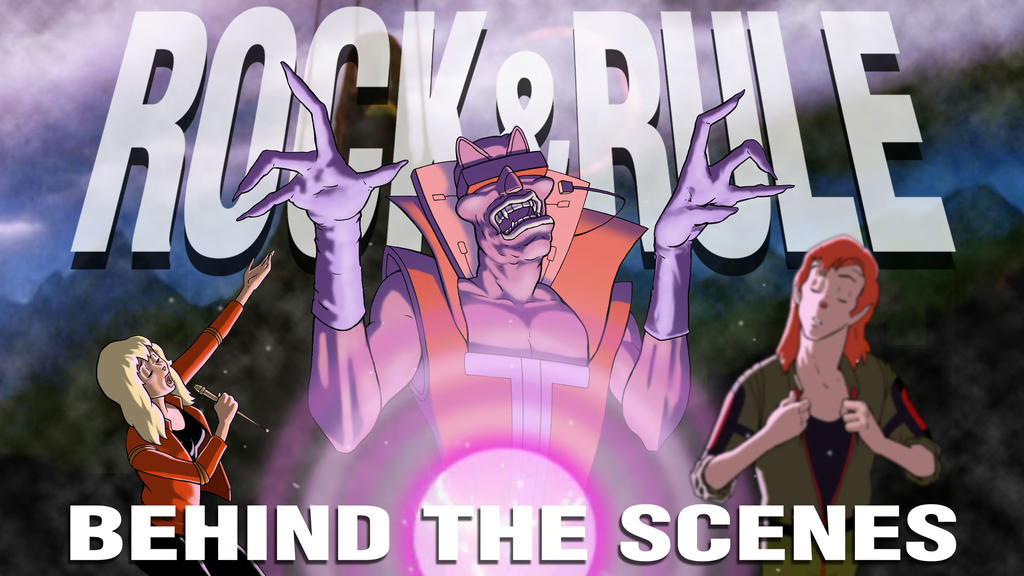

Support Rock and Rule Behind the Scenes, and get some wild extras!
In part two of our interview with Verne Andru, we look at questions fans hope the documentary will answer. Long-time fans have burning questions, and given that most of the original material was lost to a fire that Verne confirmed, what remains needs to be more than a nostalgia hit. It is a chance to look back at how technologies merged to create the cult work that Rock and Rule became, right as Hollywood was running its own experiments with transitional optical effects in films like Tron and The Last Starfighter.
What is the biggest myth about Rock & Rule that you want to address?
The studio said that the launch failed because of MGM/UA not backing it. While there may be some truth to that, it misses the point that they delivered an unfinished film years late and millions over budget. It was Nelvana’s fault, nobody else.
Were there storyboards or sequences that did not make the final cut that you still wish audiences could see?
Let’s get real clear on Rock & Rule, it was made up as we went and what were called “storyboards” were mostly scribbles. About the only pieces that would fit your description are the planning and rough posing I did for layouts, which I go into in some depth in Rock & Rule Behind The Scenes. There was some dialogue cut when they re-voiced the US (Paul Le Mat) release that should have remained, and that is the only other thing I can point to.

Fans often debate the Omar voice casting change from Greg Salata to Paul Le Mat. From an animation timing and layout perspective, did that shift affect the production, or was it largely a business decision?
That change happened light years after production. As I explain in my book, the film was pretty much ready to go and could have been released in late 1981, but it would take two more years before it finally saw the light of day. Most of the crew was let go in the summer of 1981 and I understand the re-voicing was done closer to the 1983 release date, so it had no impact on what we were doing on the shop floor.
The only crew who would have worked with the actual audio talent were animators, the rest of us got dialogue from notes on storyboards, so voice actors were not material anyway. In this case, Frank Nissen animated Omar to Greg Salata’s voice acting, which creates a certain magical quality that brings sparkle to the screen. When they brought in Paul Le Mat, he was essentially doing ADR, automatic dialogue replacement, which involves trying to match his voice to the acting nuances he sees on screen. It is a technique used a lot in live-action but loses that magical quality.
Are there additional stretch goals you are excited about if the campaign exceeds expectations?
 Yup. Rock & Rule Behind The Scenes is essentially a fundraiser for the first Captain Cannabis feature, Beginning of the End, so the more raised, the faster it gets made. I have a great stretch goal reward that will remain a surprise for the time being.
Is there anything you would like readers and longtime fans to understand about your work, or about the future of Canadian animation preservation?
I have been working “behind the scenes” for most of my career, which explains why most people probably have never heard of me, yet know my work. I developed a solid reputation early when I used my full Verne Andrusiek name, but when I pivoted into tech after Rock & Rule, I switched to Verne Andru as a professional courtesy, which no doubt has caused some awareness issues.
I created Captain Cannabis in the 1970s with the aim of bringing hope and happiness to millions. It has taken years of hard work and struggles, but the stars are finally aligning to bring this exciting universe to life, and this Kickstarter is a big move in that direction.
Rock and Rule Behind the Scenes
with Michael Hirsh
https://www.youtube.com/watch?v=ewM8lMCfHnU
