

 Drakkar Dev
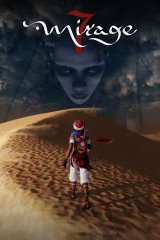
Within the heart of Mirage 7 lies a familiar game design framework. For this first-person adventure-shooter, the main difference is whether you are slinging rocks at targets or eating scorpions for dinner. Players switch between young Nadira, a desert dweller searching for her missing sister, and Jiji, the pet lizard who protects her while she sleeps. The concept itself is not especially new, but the game still has enough flavour to stand out, especially through its Arabian Nights-inspired setting and its blend of exploration, mystery, and survival.
After spending some time with the Steam version on PC, I was impressed with the story more than the actual gameplay. This game is familiar enough that the muscle memory developed by playing similar games like Tomb Raider quickly returns. The keyboard and mouse controls feel comfortable, and while I did not get a chance to test a controller, the game seems like it would lend itself well to that option too.
As I moved through the desert, I kept thinking of the games of yore. That same sense of isolation, puzzle-solving, and gradual unfolding of the narrative is all there. The only difference is that instead of treasure hunting, I’m gathering pages to a story I’ve yet to reach the climax of. Blair Greene-Osako gives Nadira a grounded presence as this young heroine searches for the legendary Princess Taishma in the Moon Palace, seemingly the only figure who can help her. That central setup is what pulled me in more than anything else. There are hints of stranger forces at work in the background, but for now, those elements feel more like noise around the edges than the main draw.

What worked best for me in these early hours is that Mirage 7 knows how to guide the player without becoming too overbearing. It is not an open sandbox, and that is perfectly fine. The game follows a more linear path, with standard puzzles and bits of dialogue that clearly signal when an action is not possible. That design choice may feel old-fashioned to some, but I did not mind it. Sometimes I would rather a game keep me moving through its story than leave me wandering in circles for the sake of freedom.
The combat and survival ideas also help give the game its own identity. Nadira’s main weapon is a slingshot, and that alone gives encounters a different feel than the usual action-adventure formula. There is also a short sword, but I found the long-distance weapon more satisfying to use. Health recovery comes from drinking water, while rest is tied to the sections where Jiji helps Nadira sleep safely. That adds a nice survival-lite touch. In a desert setting, you would think travelling at night and resting in the day would be the smarter strategy.
Because this is only a first look, I cannot yet say how well the larger story comes together or whether the game meaningfully builds on its ideas. There are hints of something bigger beneath the surface, and I am curious enough to keep playing and find out where it all leads. For now, Mirage 7 feels like a modest but intriguing adventure, one that may appeal most to players who miss that older style of guided action-adventure design.\
Pros
- Strong Arabian Nights-inspired setting with a distinct desert atmosphere
- Guided, linear progression keeps the adventure focused
Cons
- Core gameplay framework feels familiar rather than fresh
- Players wanting a true open-world sandbox may find it too restrictive
Mirage 7 Trailer
Discover more from Otaku no Culture
Subscribe to get the latest posts sent to your email.
