


One can call me a sucker for what Leigh Whannell created with the Insidious franchise. He had some great ideas concerning where one can go when either asleep or when someone has died, and has unresolved issues. Also, it’s hard to avoid making a play on words with the latest release, Insidious Out of the Further. The real question is how can this IP stay fresh six films in?
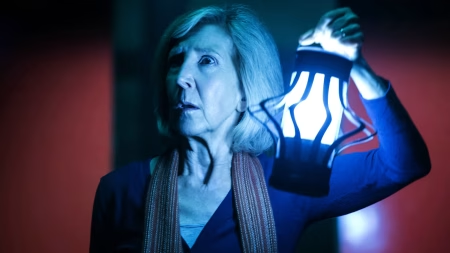
The Further is a pocket dimension which feels less like purgatory and more like a waystation to a better life. Those souls who get stuck there must have died in the worst possible ways and therefore, can’t move on. That’s either because of what they did or there’s a demon forcing them to stay. When there are other souls like Elise Rainier (Lin Shaye) choosing to remain here to help guilde the deserving out of there, I believe she’s like an Angel. The fact she’s chosen to remain behind to do this work since her death from the first film to now says everything. And when she said there’s somewhere better waiting on the other side, surely Heaven must exist.
Well, that’s my occult theory.
The opening ten minutes, showing a young Gemma (Charli Penton) living with a mother in the grip of mental illness, reveals another. That direction plants the seed for everything that follows. Twenty years later, Gemma (Amelia Eve; or Gem, as I’ll call her going forward) is a dental hygienist raising her daughter Maya (Island Austin) alone. The film keeps its focus tight on the adult rather than splitting time with Maya’s own life at school; the horror unfolds over roughly a week, and widening the lens would only bloat the story.

What we do see of their day-to-day life argues against isolation: the two of them walk to school together, wave to neighbours, and Maya has taken a liking to a dog next door that she isn’t allowed to have herself. It’s a small detail, but it keeps the world feeling lived-in rather than shut off.

That groundedness makes it land harder when Gem starts slipping into behavior that echoes her own mother’s. Her fear isn’t abstract: she’s watched Maya notice, and she’s terrified her daughter will end up carrying the same memory of her that she carries of her own mother. Whatever she buried from that childhood is working its way back to the surface.
She’s built walls since then, and that includes keeping Nick Mendoza (Brandon Perea) at arm’s length, even though he’s both her dental patient and clearly more than that to her. She’s attracted to him and doesn’t hide it well, but she’s holding back, and the film ties that hesitation to whatever went wrong with her previous husband. When she finally lets Nick in, the story’s emotional stakes stop being theoretical.


When every film in a series looks alike, it gets easy to predict what happens next. The door has closed on the Lambert family’s story, though the way the film spares a few clips tying things together suggests a bigger arc is still at work. Astral projection is the only way a mortal can reach the Further, and Dalton and Josh both had that ability. The Halls turn out to share it too, but Gem’s version runs deeper: where the boys could only travel there themselves, she can send people and objects back and forth into the Further at will. Three generations of women, tied together by that gift, is a satisfying enough throughline even if the reveal that they share it isn’t much of a surprise.
It’s exactly what makes Gem valuable to Cyrus (Sam Spruell), a man who turned into a demon after leading a death cult in life. He promised his followers that dying wasn’t an ending but a beginning, offering them a ritual death and a return. The cult didn’t last and neither did he, but once he learns what Gem can do, he starts stalking the family, looking to convert whoever he can and build a new hell on Earth with them. It’s another box checked off the trope list. Whatever this film is, an original like Insidious it is not.
Nearly every soul in the Further wants something. Cyrus’s followers might get a shot at returning to life, though not for reasons worth rooting for. There’s a darker logic underneath it too: some ghosts stay stuck because they never made peace with the people they left behind, and only reconciliation lets them move on. That’s exactly what Gem is afraid of leaving unresolved. Her own illness is catching up with her, and she’s worried about what she’ll leave her daughter to carry.
Short of someone showing up with a bright studio lamp, everyone in this realm stays miserable, and that’s never going to change. Lighting the place wouldn’t fix what’s wrong with it anyway; it’s a sci-fi fix being asked to solve a horror problem, and the film wisely doesn’t go there. If it were possible, I’d guess Elise’s spirit would take on the job herself, since she can’t return from the dead either.


The finale leans hard on that moment from the original film when the house gets sucked away, and even though that never technically happened, I still snickered at the fate of the Hall house. Set against Freddy from A Nightmare on Elm Street, though, I liked what Wes Craven’s creation did more. He had more personality.
And the people worth fearing aren’t the creatures native to the Further. They’re the ones skilled at astral projection, moving back and forth through dreaming or other means. Those with the gift only fear what they might create if they lose control, and when they do, everyone else should watch out.
This film plants the seeds of a genuinely good idea, and the real question it raises is how anyone could actually get there. Its answer: it’s as easy as falling asleep. Not everyone can lucid dream, though, and that gap is worth exploring rather than skipping past. The earlier films only played lightly with that idea, and this one stays just as light, never digging into why losing control of your own dreams is disastrous.
Which raises the bigger question: how does this franchise stay fresh going forward? I don’t want a retread of what Nightmare did with its third through fifth films, the Dream Warriors-to-Dream Child stretch. With this latest entry, I fear that’s what screenwriters David Leslie Johnson-McGoldrick and Jacob Chase (who also directed) are leaning towards. To go in this direction is bad, instead of taking the story somewhere genuinely new. Or let’s phrase my hope this way: the farther their ideas drift away from the source material, the more hopeful I am.
3 Stars out of 5
Insidious Out of the Further Trailer
