

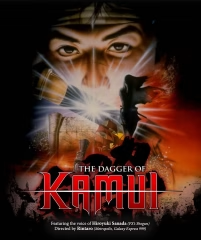
Available to purchase on Amazon USA

Any fan of Madhouse Animation‘s vast catalogue should take another look at Dagger of Kamui. Not only is it a seminal work that shows what this studio loves best, it’s a strong early showcase for their visual style. From Neo Tokyo to Paprika, they covered a lot of ground over the decades, and more recent productions like Goodbye, Don Glees! show they never really stopped pushing.
This 1985 film was an early feature effort for director Rintaro, but what he brought to make this ninja epic a genuine classic is a soundtrack that follows the rhythm of each act. Whether that’s the folk-tinged percussion of a sequence involving people living much like the Ainu of northern Japan, the whistle of the Wild West, or the rock-inflected energy that underscores the Edo-period chaos, the score is a big reason this film still holds up.
Here, Jiro must reclaim his identity and figure out who killed his adoptive family. He was certainly framed, and although the monk Tenkai takes him in and trains him as a weapon, what Jiro uncovers along the way ends up being far more layered than a simple tale of revenge. Not only must he discover his heritage, but he’ll have to track down who has truly been pulling the strings his entire life. It’s a story that goes deeper in manga form, and what the film does is compress some storylines while expanding on the historical significance of the era it takes place in.
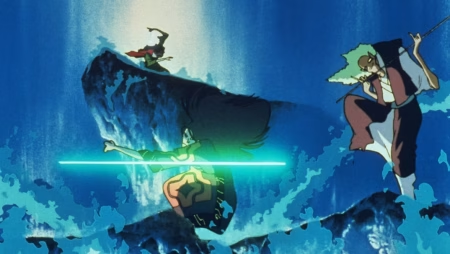

As a work that set a precedent for future storytellers, even Yasuomi Umetsu later of Kite fame, owes a small debt to his time working on this film as an animator. As for the historical grounding, there are references throughout to the major upheavals of late Edo and early Meiji Japan. The film spends a significant stretch during the Boshin War, and the liner notes do a better job of explaining its significance for anyone wanting to go deeper. The included booklet also covers the choices made to bring this to a modern audience and contextualizes the history well.
As for why Jiro matters, he’s been called “the Forrest Gump of ninjas.” He accidentally wanders through the major geopolitical shifts of the 19th century. One moment he’s dealing with Shogunate assassins, and the next he’s caught up in a shootout in a frontier town or tangled in the American Civil War. And seeing a Japanese production imagine the Wild West is something to behold. It’s familiar but strangely appropriate. It actually reminded me of Future Boy Conan, that same sense of a young person moving through a world that’s bigger and stranger than anything they were prepared for.
In short, check it out if you want to see what happens when world-class animators are given a substantial budget and told to make the most stylish, globe-trotting ninja film possible. The video quality Blu-ray release doesn’t offer a huge difference when compared to prior optical disc versions, as the colour palette reads similarly. The higher bitrate and resolution do yield a sharper image, and the soundtrack has noticeably better dynamic range when piped through a receiver. The odd bit of pixel dotting appears here and there, though it’s not distracting and may well be source-original. It’s absolutely worth the upgrade if you’re coming from an early AnimEigo release. Ultimately, it’s the liner notes and and the newly recorded commentary with Rintaro which makes purchasing worthwhile.
Dagger of Kamui Trailer
